ASTM A653 Standard Specification for Steel Sheet, Zinc Coated (Galvanized) or Zinc Iron Alloy Coated (Galvannealed) by the Hot Dip Process

    What is ASTM A653?

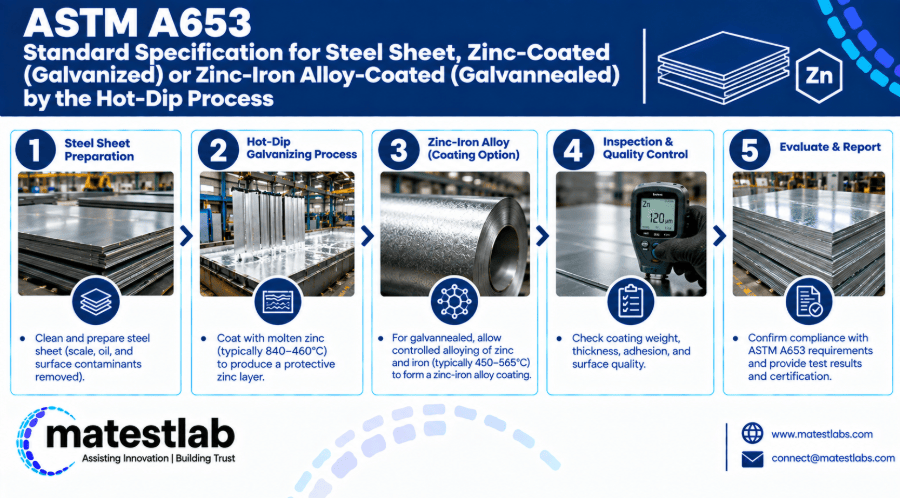
    ASTM A653 is a standard specification for zinc-coated (galvanized) or zinc-iron alloy-coated (galvannealed) steel sheet, in coils and cut lengths, for hot-dip coating. The product is manufactured in zinc (or zinc-iron alloy) coating weights or coating designations of various thicknesses. Product furnished in accordance with this specification shall comply with the requirements of the latest version of Specification A924/A924M, except as otherwise herein provided. The product comes in various designations, grades, and classes in four broad categories corresponding to the various application requirements. The values given in either inch-pound units (as A653) or SI units (as A653M) are to be considered as standards in their own right.

    Read more

    Get Certified ASTM A653 Testing for Reliable Textile Flame Resistance Assessment

    Certification guarantees that zinc-coated and zinc-iron alloy-coated steel sheets are tested against standards of coating weight, chemical composition, and mechanical properties and are accurately evaluated for them through standard testing procedures. The experienced laboratory testing allows manufacturers and fabricators to confirm corrosion resistance, formability, and structural integrity. ASTM A653-certified testing supports quality control, material verification, and product development in construction, automotive, appliance, and HVAC applications. Laboratory services ensure that the tests are performed under standard requirements and give confidence in the results. For critical applications, quality control professionals and materials engineers depend on certified testing to ensure uniformity of the coating and mechanical properties.

    What is the Scope of the ASTM A653 Standard? 

    ASTM A653 covers the specification for steel sheet, zinc-coated (galvanized) or zinc-iron alloy-coated (galvannealed) by the hot-dip process, in coiled and cut lengths. The product is manufactured in different coating weights or coating designations, and the specification includes chemical composition, mechanical properties, coating weight, and dimensional tolerances. 

    Read more

    The scope of ASTM A653 includes: 

    • Material type: Coils and cut lengths of steel sheet, hot-dip zinc-coated (galvanized) or hot-dip zinc-iron alloy coated (galvannealed).
    • Purpose: Galvanized and galvannealed steel sheet for corrosion resistance, formability, and structural requirements.
    • Properties measured: Coating weight (triple spot, single spot), Yield strength, Tensile strength, Elongation, Coating adhesion.
    • Method: The coating weight test, the tensile test, and the bend test are used to verify the coating adhesion of the hot-dip coating process using zinc or zinc-iron alloy.
    • Result: Report coating weight designation, mechanical property values, and chemical composition compliance.
    • Test Limitations: The standard is not intended to cover all safety aspects of its use.
    • Environmental conditions: Tested under controlled conditions at ambient temperature in the laboratory. Mechanical property numbers are for as-received material and are not necessarily related to performance in elevated temperature service or long-term corrosion behavior.
    • Applications: Automotive body panels, roofing and cladding, HVAC ductwork, appliances, and framing and structural parts. 

    What are the Uses of ASTM A653?

    ASTM A653 testing helps manufacturers and fabricators to assess the quality and performance characteristics of galvanized and galvannealed steel sheet. Test results are used in quality control, material verification, and product development. This standard is widely used in the construction industry, the automotive industry, appliances, and HVAC. This standard-

    • Checks coating weight for protection against corrosion.
    • Confirms chemical composition of the base steel.
    • Tests mechanical characteristics for shaping and construction.
    • Provides adhesion of coating during bending and stamping.
    • Assists in selecting and sourcing materials.
    • Allows for conformance with building codes and automotive specifications.
    • Responsible for quality assurance of roofing, HVAC, and appliance applications.

    Which materials can be tested under ASTM A653?

    ASTM A653 is applicable to steel sheet that is coated with zinc or zinc-iron alloy as a hot-dip coating. The product comes in four broad categories: commercial steel, forming steel, deep drawing steel, and structural steel. Typical sizes are SS Grade 33, SS Grade 37, SS Grade 40, SS Grade 50, and SS Grade 80. The base metal has controlled levels of carbon, manganese, phosphorus, sulfur, and other alloying elements.

    Why is ASTM A653 Important? 

    The ASTM A653 specification details a standard for galvanized and galvannealed steel sheet for applications that call for both corrosion resistance and formability. The specification provides requirements on coating weight, chemical composition, and mechanical properties to guide the manufacture of a uniform and sound product. The standard helps to guarantee consistency of product features and function between suppliers. This specification is used in industries like construction, automotive, and appliances to guarantee the durability of roofs, quality of body panels for automobiles, and performance of HVAC ductwork. The hot-dip coating method gives a metallurgically bonded zinc coating that protects the steel substrate through barrier protection and sacrificial cathodic action.

    ASTM A653 Equipment and Sample Preparation Guide

    ASTM A653 specifies that galvanized and galvannealed steel sheet be measured using apparatus for coating weight, chemical analysis, mechanical testing, and bend testing. Representative specimens are carefully prepared in laboratories for coating, chemical analysis, and mechanical property tests. The equipment includes a coating weight test setup, spectrometer, tensile testing machine, and bend testing apparatus.

    Read more

    Sample and Specimen Details Samples need to be a representative part of the production lot. They come in commercial steel, forming steel, deep drawing steel, and structural steel designations. 
    Specimen Preparation Technicians prepare specimens for coating weight, chemical, and mechanical testing with required dimensions. They remove damage and contamination from surfaces of specimens. They prepare specimens following the requirements of Specification A924/A924M. 
    Coating Weight and Steel Category Technicians select the coating weight designation, such as G60 or G90, together with the steel category ordered, since these determine the applicable test method and acceptance limits for each specimen. 
    Instrumentation Technicians use a coating weight test apparatus (stripping solution and balance), a spectrometer for chemical analysis, a universal testing machine for tensile and yield strength, a bend testing apparatus (180° bend fixture), and dimensional measurement tools. 

    Testing Procedures and Requirements for ASTM A653

    ASTM A653 testing establishes that the coating weight, chemical composition, and mechanical properties of galvanized and galvannealed steel sheet are in compliance with the specified standards. Engineers conduct tests using standardized procedures to ensure reliable, accurate results. Technicians prepare specimens, conduct tests, and write up results. Other referenced ASTM documents include ASTM A90, A568, A902, and A924.

    Read more

    Specimen Preparation and Mounting Technicians cut specimens to 76 mm × 300 mm and mount them lengthwise in the specimen holder. They align the holder sides and clamp the fabric to prevent movement during testing.
    Burner Flame Adjustment Technicians adjust the burner to produce a 38 mm long flame. They check the flame height with the flame measurement device and make sure that the flame is consistent from the gas supply.
    Flame Exposure Technicians place the burner below the specimen, 19 mm from the fabric. They hold the specimen in the flame for 12 seconds and then withdraw the burner from the flame.
    Afterflame and Afterglow Measurement The afterflame time (time of flaming after the flame is removed) and afterglow time (time of glowing after the flame extinguishes) are observed and recorded.
    Char Length Measurement The char length is measured as the weight is applied to the specimen, and the distance that has been burned from the edge exposed to the flame to the end of the burned area is measured. Analysts documented and reported the results.

    ASTM A653 Testing Process and Data Collection

    The specimen preparation for the testing process starts by cutting the specimen into 76 mm × 300 mm pieces and placing the pieces in the specimen holder. The burner flame is set at 38 mm, and the burner is set 19 mm away from the specimen. They place the specimen in the flame and remove the burner after 12 seconds. They observe and record the afterflame time and afterglow time. The char length is measured by weighing the sample and tearing it into pieces to determine the distance from the burnt edge to the burnt end. Afterflame time, afterglow time, and char length are recorded for each specimen. Laboratories gather data to manage quality, product qualification, and regulatory requirements.

    The image shows a coated steel sheet sample undergoing coating-weight and tensile testing under ASTM A653.
    ASTM A653 Coating Weight and Tensile Testing of Galvanized Steel Sheet

    Common Challenges and Troubleshooting

    Technicians take readings at several points around a coil edge to ensure consistent readings from the triple spots and for an accurate average reading. Surface contamination also affects the adhesion results, and specimen cleaning prior to testing helps to prevent this. Mechanical properties tend to wander from the specified limits as furnace temperature fluctuates in the hot dip process; adjusting the line controls and retesting the affected lot corrects this problem. Regular equipment calibration and trained personnel minimize these challenges throughout a testing program.

    ASTM A653 Analysis Results and Interpretation

    The report provides a summary of the properties measured in the coated steel specimens following the appropriate ASTM A653 tests. The test sheet is then compared to the specification limits of the ordered category and coating specification.

    Read more

    • The laboratory measures coating weight in oz/ft² or g/m² and records the triple-spot and single-spot results for the coating designation.
    • The analyst records the mechanical properties, including yield strength, tensile strength, and elongation, in the units specified by the ordered steel category.
    • The laboratory reports the chemical composition as weight percent (wt.%) for each specified alloying element.
    • The report contrasts bend and adhesion observations with specification requirements and notes whether cracking and/or flaking occurred, rather than assigning a single overall performance value. 

     Link to ASTM A653

    FAQ

    Which products does ASTM A653 apply to?
    ASTM A653 is for steel sheet hot-dip coated with zinc or a zinc-iron alloy, and provided in coils and cut lengths for use in construction, automotive, and appliance applications.
    Galvanized sheet is coated with a pure zinc layer, while galvannealed sheet is coated with a zinc-iron alloy layer, which is applied by an additional heat treatment at the mill to enhance paint adhesion and weldability.
    Depending on the exposure conditions, heavier designations like G90 are suitable for outdoor and structural applications, and lighter designations like G30 or G60 are suitable for painted or indoor component applications.
    Laboratories typically run coating-weight determination, tensile testing, bend testing, adhesion testing, chemical composition analysis, and dimensional inspection to confirm compliance.

    Updated on September 30, 2026

    Divakar Shukla
    About Author
    Divakar Shukla is an Electrical and Electronics Engineer specializing in the convergence of embedded systems architecture, industrial automation, and applied artificial intelligence.
    Know More
    Testimonials
    Real results
    Engineers trust us with what matters most
    Start Your Testing
    Project Today
    Define your requirements and get access to
    specialized laboratories ready to deliver results
    Partners with us
    Clients
    Vendors
    Process for testing
    • STEP 01

      You share your testing requirements

    • STEP 02

      You share your sample(s)

    • STEP 03

      We deliver your test reports

    Get your testing done

    Let us know your testing requirements and we will be right back with a solution.

      Let us root for each other. Collaborate to grow, expand, and accelerate our businesses.

      Partner with us

        Discover more from Matestlab

        Subscribe now to keep reading and get access to the full archive.

        Continue reading