ASTM A327 Standard Test Methods for Impact Testing of Cast Irons

    What is ASTM A327?

    ASTM A327 is the standard test method for impact testing of cast irons. It offers standardized procedures for determining the impact resistance of cast iron materials by measuring the amount of energy that is absorbed during a single high-speed impact. This is a destructive test.  Several types of cast iron, such as gray iron, white iron, malleable iron, ductile iron, and Austempered ductile iron (ADI), are covered by the standard. ASTM A327 calls for the use of either cylindrical Charpy specimens or standard notch and unnotched Charpy specimens, depending on the material. The test results give engineers a means of comparing the toughness of materials, checking manufacturing quality, and confirming engineering specifications.

    Read more

    Get Certified ASTM A327 Impact Testing for Cast Iron Components

    Cast iron components are often subjected to impact loading, vibration, and dynamic service conditions, making impact toughness a critical material property. ASTM A327 testing is used to determine a material’s ability to withstand impact energy absorbed prior to fracture, which allows the manufacturer to recognize brittle materials before they are used in real-world applications. Professional impact testing improves product quality, satisfies customer requirements, enhances operational reliability, and reduces the risk of unexpected component failures.

    What is the Scope of ASTM A327 Test Standard?

    The ASTM A327 test method provides standard methods for the Charpy impact test for the determination of impact toughness of cast iron materials. The standard specifies the conditions for specimen preparation, testing equipment, the testing method, and reporting the test results to ensure uniformity for the evaluation of a material’s resistance to sudden impact loading and brittle fracture.

    Read more

    • Applies to gray iron, white iron, malleable iron, ductile iron, and austempered ductile iron (ADI).
    • Develops standard Charpy impact test procedures.
    • Defines the cylindrical and standard Charpy specimen shapes.
    • Establishes the needs for specimen preparation and testing.
    • Measures the energy absorbed during fracture under impact loading.
    • Assists with the quality control and acceptance testing of materials.
    • Applicable to the measurement of impact toughness (absorbed impact energy) of cast iron materials.

    What is the Use of ASTM A327 Testing?

    The ASTM A327 test is used to evaluate the impact toughness and fracture resistance of cast iron materials under sudden loading. The Charpy impact test measures the energy absorbed by a specimen during fracture and assesses the material’s resistance to brittle failure under impact conditions. ASTM A327 testing supports quality assurance, material selection, and verification of compliance with applicable material specifications.

    • Measures impact toughness of cast iron materials.
    • Evaluates resistance to sudden impact loading and susceptibility to brittle fracture.
    • Checks the quality of material in critical cast iron parts.
    • Assists in quality control during foundry production.
    • Supports the qualification of materials for engineering uses.
    • Compares the impact toughness of different grades of cast iron.
    • Assists in product certification and acceptance testing.

    What Materials Can Be Tested Under ASTM A327?

    ASTM A327 covers gray iron, white iron, malleable iron, ductile iron, and austempered ductile iron (ADI). The standard is not applicable to chilled rolls or rolls with white iron skins. The Charpy impact test is used to measure the absorbed impact energy and evaluate the impact toughness of the material under impact of cylindrical Charpy specimens or standard notched/unnotched Charpy bars, depending on the material being tested.

    Why is ASTM A327 important in the case of cast iron parts?

    Brittle fracture can cause a sudden failure of equipment, especially when many cast iron items are subjected to dynamic or shock loading. ASTM A327 is a standard test method for determining the impact toughness of various grades of cast iron using the Charpy impact test. Compliance with the standard helps select materials, increases the reliability of products, facilitates quality control, and minimizes unexpected failures in automotive, machinery, mining, agricultural, and heavy engineering applications.

    Common challenges and troubleshooting

    For accurate impact testing, proper specimen machining, correct notch geometry (where applicable), and accurate span dimensions are needed, along with a calibrated pendulum impact machine. The most frequent causes of error are improper preparation of specimens, incorrect specimen alignment, worn anvils, inaccurate machine calibration, and anvil interference during fracture. Multiple specimens, as required by ASTM A327, increase the reliability of test results and reduce variation due to material discontinuities.

    ASTM A327 Testing Process and Data Collection

    Representative cast iron specimens are selected from the material being tested. Specimens are prepared in accordance with the specified Charpy specimen size and tested in the pendulum-type Charpy impact test machine at room temperature. During testing, the following information is recorded: absorbed impact energy, specimen dimensions, fracture appearance, and the testing condition. ASTM A327 recommends testing multiple specimens, as specified by the applicable material specification or testing requirements, to obtain representative impact toughness values for the cast iron being evaluated. The recorded values are then compared with the relevant material specifications or customer requirements.

    ASTM A327 Equipment and Sample Preparation Guide

    Accurate and repeatable impact test results can only be obtained by proper specimen preparation. ASTM A327 defines the specimen geometry, machining requirements, and test conditions depending upon the type of cast iron being evaluated. Specimens are carefully prepared, and testing equipment is calibrated for accurate measurements of impact toughness and fracture behavior.

    Read more

    Sample and Specimen DetailsRepresentative samples of gray iron, white iron, malleable iron, ductile iron, or austempered ductile irons are machined for impact testing. Depending on the cast iron grade, ASTM A327 specifies either cylindrical impact specimens or standard notched or unnotched Charpy specimens for impact testing.
    Specimen PreparationSpecimens are prepared with the required cylindrical or standard Charpy shape with the specified notch geometry (where applicable) and have a smooth surface finish and dimensional accuracy.
    Specimen DimensionsThe standard specifies 22 mm (0.866 in.) diameter × 22 mm (0.866 in.) long cylindrical specimens for gray and white irons. Malleable and ductile irons are tested on standard 10 × 10 × 55 mm Charpy specimens (with a notch or without, depending on the material).
    InstrumentationPendulum-Type Charpy Impact Testing Machine, Specimen Alignment Anvils, Notch Broaching Machine (for V-notch specimens), Vernier Caliper, Micrometer

    ASTM A327 Sample Requirements and Testing Procedures  Guide

    ASTM A327 defines the standard Charpy impact testing methods for toughness testing of various types of cast iron. The standard specifies the type of specimen configuration, the impact test conditions, and the measurement procedures to ensure the repeatability and accuracy of the results of impact energy.

    Read more

    Another referenced ASTM standard is ASTM E23.

    Specimen Preparation The analyst prepares representative cast iron specimens in the proper cylindrical or Charpy specimen geometry for testing, as required by the test method. 
    Charpy Impact TestingUse a calibrated pendulum-type Charpy impact testing machine to perform the impact test and measure the energy absorbed when the specimen fractures. The pendulum hammer strikes the specimen, fractures it, and records the absorbed energy.
    Impact Energy MeasurementThe analyst then measures the energy absorbed after the specimen has fractured and determines the toughness properties of the material.
    Result EvaluationThe analyst compares the measured absorbed energy values with the acceptance requirements specified by the applicable material specification or purchaser requirements.
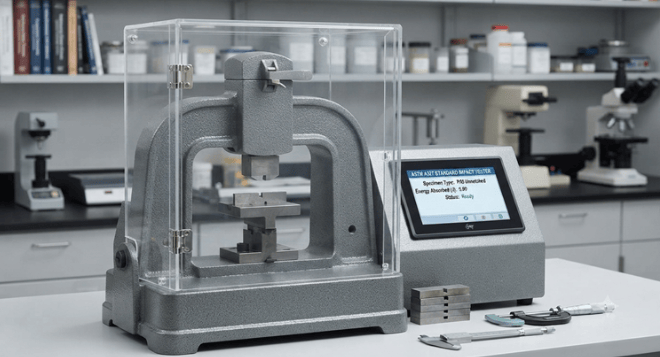
    The image shows an impact testing machine to assess the impact toughness of different grades of cast iron as described in ASTM A327.
    ASTM A327 Impact Tester 

    Analysis Results and Interpretation

    • ASTM A327 is used to measure the energy absorbed during fracture of cast iron. 
    • The results of a test are usually expressed in joules (J) or foot-pounds of force (ft·lbf) and include the type and size of the specimen tested. 
    • The measured impact energy is used to assess the toughness and impact resistance of the material. 
    • The absorbed energy is typically higher for higher toughness and lower for higher brittleness. The results are used to compare material grades, verify manufacturing quality, and support engineering acceptance requirements.

    What are the Factors to Consider for ASTM A327 Testing?

    The following can be considered while choosing a lab for this testing.

    Read more

    • Speed: Quick specimen preparation and impact testing help manufacturers confirm material toughness without delaying production.
    • Expertise: Accurate machining of specimens, proper Charpy machine calibration, and correct interpretation of fracture behavior require trained laboratory personnel.
    • Cost: Early identification of materials that lack impact toughness prevents failures, decreases warranty claims, and decreases long-term maintenance costs.

    Link to ASTM A327

    FAQ

    Where can I get the astm a327 tested?
    You can share your astm a327 testing requirements with MaTestLab. MaTestLab has a vast network of material testing laboratories, spread across the USA and Canada. We support your all material testing needs ranging from specific astm a327 test to various testing techniques.
    Please contact us for a detailed quote for your astm a327 testing needs. Cost incurred to carry out different astm a327 testing methodology depends on the type of raw material; number of samples, coupons, or specimens; test conditions, turn around time etc. Costs of some ASTM testing methods start from $100 and the final value depends upon the factors listed above. Please contact us for the best and latest prices.
    The required number of samples or specimens should comply with the procedure given in the astm a327 standard. However, the MaTestLab operations team can assist you for your special requirements once you share your testing details with us.
    MaTestLab has a vast testing laboratory network, hence we bring you the best testing facilities in a cost-effective way. We offer considerable discounts (15-20%) to our returning customers based on test volume and frequency.
    The turnaround time for astm a327 test methodology depends upon the test procedure mentioned in the standard test document. However, we at MaTestLab understand your research requirements and hence try to get your test completed within the least possible time.
    Suyog Kamble
    About Author
    Suyog Kamble
    Suyog Kamble is an Operations Associate at MaTestLab Inc. and holds a postgraduate degree in Organic Chemistry.
    Testimonials
    Real results
    Engineers trust us with what matters most
    Start Your Testing
    Project Today
    Define your requirements and get access to
    specialized laboratories ready to deliver results
    Partners with us
    Clients
    Vendors
    Process for testing
    • STEP 01

      You share your testing requirements

    • STEP 02

      You share your sample(s)

    • STEP 03

      We deliver your test reports

    Get your testing done

    Let us known your testing requirements and we will be right back with a solution.

      Let us root for each other. Collaborate to grow, expand, and accelerate our businesses.

      Partner with us

        Contact Us

        Discover more from MaTestLab

        Subscribe now to keep reading and get access to the full archive.

        Continue reading