ASTM A123 Zinc (Hot-Dip Galvanized) Coatings on Iron and Steel Products

    What is ASTM A123? 

    ASTM A123 is a standard specification for hot-dip galvanizing iron and steel products to protect against corrosion. It covers instructions for the galvanizing process, including coating thickness, appearance, adherence, and application. Clean steel parts are placed in molten zinc under controlled conditions to produce an even coating. The zinc coating shields against moisture, oxygen, and environmental exposure. ASTM A123 (Standard Specification for Zinc (Hot-Dip Galvanized) Coatings on Iron and Steel Products) supports laboratory testing, reliability checks, performance evaluation, quality assurance, and specification purposes. It ensures consistent quality, durability, and longevity for products used in construction, energy, and transportation industries. 

    Read more

    Get Certified ASTM A123 Reliable Hot-Dip Galvanizing and Coating Performance Compliance.

    ASTM A123/A123M allows qualified galvanizing facilities to assess the performance of hot-dip galvanized coatings on applicable iron and steel products. Professionals can examine the surface to be galvanized, check the surface thickness, assess the coating condition, and record the testing results according to the requirements. Laboratories and inspection organizations should ensure reliable results by using calibrated instruments, proper sampling methods, trained staff, and well-documented quality control processes. 

    What is the Scope of ASTM A123? 

    ASTM A123 is applicable to the zinc coatings applied to rolled, pressed, and forged iron and steel products, castings, plates, bars, and strips by hot-dip processes. It includes fabricated items, including assembled steel products, structural steel fabrications, large tubes bent or welded prior to galvanizing, and wire work fabricated from uncoated steel wire. The specification also covers some steel forgings and iron castings used in fabricated items. The scope of ASTM A123 includes-

    Read more

    • Material type: Iron and steel products receiving hot-dip zinc coatings.
    • Testing: Evaluation of zinc coating requirements on rolled, pressed, forged, cast, plate, bar, strip, and fabricated iron and steel products.
    • Property measured: Zinc coating thickness and, where applicable, coating mass.
    • Proposed Method: Inspect galvanized articles and determine coating thickness using appropriate coating-measurement methods at representative locations.
    • Result: Coating measurements used to determine compliance with the applicable ASTM A123 requirements.
    • Test Limitations: The specification does not cover wire, pipe, tube, or sheet galvanized on specialized or continuous lines, or steel products thinner than 22 gauge (0.0299 in. [0.76 mm]).
    • Environmental conditions: Testing and inspection require controlled conditions appropriate for accurate coating measurements and visual evaluation.
    • Applications: Quality control and acceptance of hot-dip galvanized structural steel, fabricated products, castings, forgings, reinforcing steel assemblies, and other applicable iron and steel products.

    What are the Uses of ASTM A123Testing?

    ASTM A123 testing helps laboratories evaluate the quality and performance of hot-dip galvanized iron and steel products. Manufacturers, engineers, and quality control personnel use the results for quality assurance, material verification, and compliance testing. This standard-

    • Checks the thickness, uniformity, and adherence of hot-dip galvanized coatings.
    • Provides corrosion protection verification for structural steel and fabricated components.
    • Ensures compliance with ASTM specifications and regulations.
    • Evaluates surface finish, aesthetics, and tolerances for defects.
    • Improves product durability and service life through quality coating verification.
    • Lowers life-cycle maintenance and repair costs.
    • Establishes coating quality standards for construction and infrastructure projects.

    What Materials Can Be Tested Under ASTM A123? 

    ASTM A123 covers hot-dip galvanized iron and steel products after fabrication. It applies to products such as rolled, pressed, and forged products, castings, plates, bars, and strips. The specification includes both unfabricated and fabricated products, such as assembled steel products, wire work that manufacturers fabricate from uncoated steel wire, structural steel fabrications, and large tubes that manufacturers bend or weld before galvanizing. The specification does not cover wire, pipe, tube, or steel sheet that manufacturers galvanize through continuous processes, nor does it cover steel thinner than 22 gauge (0.0299 in.). 

    Why is ASTM A123 Important? 

    ASTM A123 specifies uniform requirements for hot-dip galvanized zinc coatings on iron and steel products. The specification correlates the minimum required coating with the material category and measured steel thickness to provide a suitable coating level for various products. It also provides inspection and acceptance criteria to enable users to judge the quality and conformance of galvanized products.

    ASTM A123 Equipment and Sample Preparation Guide

    ASTM A123 specifies various inspection and testing equipment for evaluating hot-dip galvanized coatings. Representative samples of galvanized iron and steel products are tested in the laboratory to determine coating quality and performance. 

    Read more

    Sample and Specimen DetailsTechnicians test representative samples of hot-dip galvanized iron and steel products in the laboratory to evaluate coating thickness, adherence, and appearance.
    Specimen PreparationTechnicians clean and prepare galvanized samples for inspection and measurement. Technicians select sample members from each lot and divide them into specimen areas for testing.
    Specimen DimensionsFor members up to approximately 65 feet long, technicians divide sample members into three specimen areas (near each end and near the center). Longer members require four specimen areas plus one additional interior location.
    InstrumentationLaboratories use a coating thickness gauge (magnetic/electronic), visual inspection tools, micrometers or calipers, surface cleanliness tools, and adherence testing equipment (bend or impact test apparatus).

     Testing Procedures and Requirements for ASTM A123

    This test standard uses inspection and testing procedures to evaluate hot-dip galvanized coatings on iron and steel products. Technicians perform visual inspection, coating thickness measurement, and adherence testing, and the apparatus completes the evaluation. Referenced documents include ASTM A153, A767, A780, and B499. The ASTM A123 test method comprises the following test procedure.

    Read more

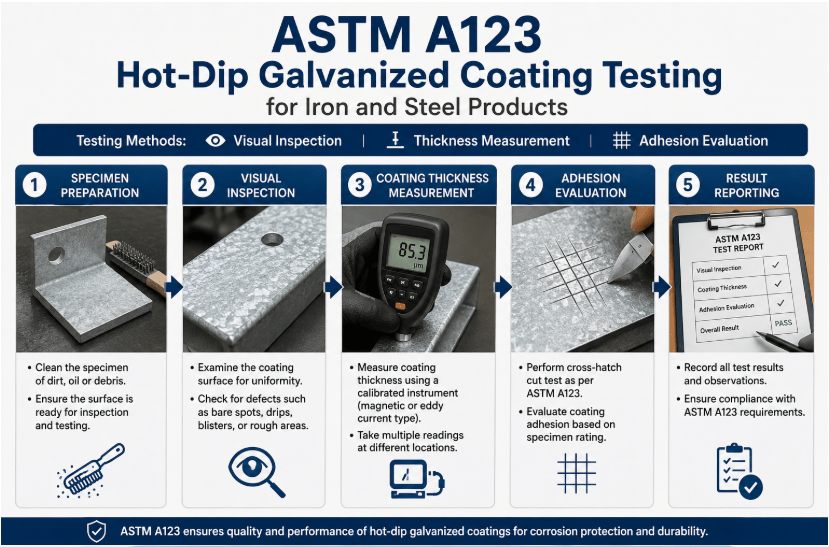
    Specimen Preparation & Conditioning Technicians select sample members from each lot according to ASTM A123 Section 7.3 and divide them into specimen areas for inspection.
    Visual Inspection Technicians examine the coating for surface defects, uniformity, and finish under adequate lighting conditions (≥300 lux). They rotate parts to view all angles.
    Coating Thickness Measurement Technicians measure coating thickness using magnetic or electronic gauges calibrated per ASTM B499. They take a minimum of five widely dispersed measurements on surfaces that represent the coating based on observed uniformity.
    Adhesion Evaluation Technicians check coating adherence using standardized methods such as bend tests, impact tests, or file tests. The coating must not flake or peel after testing. 
    Result Reporting Laboratories report coating thickness measurements, surface quality and defect analysis, adhesion test results, and compliance certification as per ASTM A123.

    ASTM A123 Testing Process and Data Collection

    The ASTM A123 evaluation begins by identifying the galvanized product and selecting test articles that represent it. The inspector determines the material category and steel thickness to establish the required coating. The inspector then checks the surface and conducts coating-thickness tests at various representative locations. The inspector uses the collected measurements to assess specimen and average coating thickness against the applicable requirements in the specification. 

    The image shows hot-dip galvanized coating testing by visual inspection, thickness measurement, and adhesion evaluation, including specimen preparation, visual inspection, coating thickness measurement, adhesion evaluation, and result reporting.
    ASTM A123 Hot-Dip Galvanized Coating Testing for Iron and Steel Products

    Common Challenges and Troubleshooting

    Poor adhesion and uneven coating thickness are usually caused by poor surface preparation. An example of this is that contaminants may interfere with proper bonding. Moreover, peeling or blistering can be induced by the wrong bath temperature or immersion time. Thus, pre-treatment is controlled, and the correct chemical composition enhances the quality of the coating. The stable bath conditions also guarantee homogeneous results.

    ASTM A123 Analysis Results and Interpretation

    The report summarizes the coating thickness, surface appearance, and adhesion of hot-dip galvanized iron and steel products. The results help inspectors and engineers evaluate the galvanized coating and compare the measured properties with applicable material or product requirements.

    Read more

    • The laboratory reports coating thickness in µm or mils and compares the measured values with the minimum average coating thickness required for the applicable material category and steel thickness.
    • The coating thickness represents the zinc layer thickness on the product. The material category and measured steel thickness determine the minimum average coating thickness. The minimum average coating thickness ranges from 45 µm to 100 µm, depending on the material category and steel thickness.
    • Analysts evaluate the galvanized surface for appearance, including visible roughness, non-uniformity, or other coating conditions that could interfere with the product’s intended use.
    • The technician evaluates coating adherence using the applicable examination method and documents any flaking, peeling, or other evidence of inadequate bonding.
    • The laboratory records the material category, product identification, coating thickness measurements, surface observations, and applicable test results to support evaluation of the galvanized product.
    • Engineers compare the reported coating properties and observations with the applicable specification requirements to determine whether the galvanized product is suitable for its intended use.

    Link to ASTM A123

    FAQ

    What does ASTM A123 cover?
    ASTM A123 covers iron and steel products made from rolled, pressed, forged, or cast shapes that manufacturers coat with zinc through hot-dip galvanizing. The standard covers both manufactured and unmanufactured products.
    ASTM A123 defines zinc coatings produced through the hot-dip galvanizing process. The standard specifies coating requirements according to the product category and measured steel thickness.
    ASTM A123 covers structural shapes, plates, bars, strips, castings, forgings, fabricated assemblies, structural steel fabrications, large tubes that manufacturers bend or weld before galvanizing, and wire work that manufacturers fabricate from uncoated steel wire.

    Updated on September 10, 2026

    Suyog Kamble
    About Author
    Suyog Kamble is an Operations Associate at Matestlab Inc. Suyog holds a postgraduate degree in organic chemistry and is trained in material science topics.
    Know More
    Testimonials
    Real results
    Engineers trust us with what matters most
    Start Your Testing
    Project Today
    Define your requirements and get access to
    specialized laboratories ready to deliver results
    Partners with us
    Clients
    Vendors
    Process for testing
    • STEP 01

      You share your testing requirements

    • STEP 02

      You share your sample(s)

    • STEP 03

      We deliver your test reports

    Get your testing done

    Let us know your testing requirements and we will be right back with a solution.

      Let us root for each other. Collaborate to grow, expand, and accelerate our businesses.

      Partner with us

        Discover more from Matestlab

        Subscribe now to keep reading and get access to the full archive.

        Continue reading