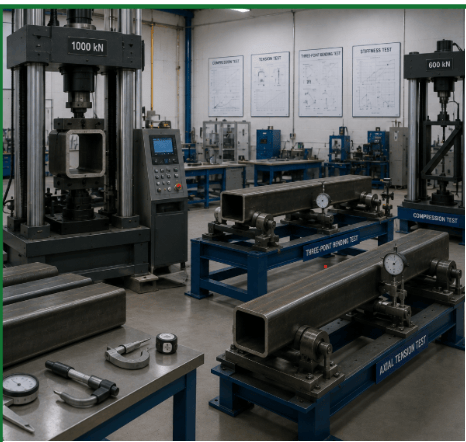
ASTM A1085 specifies the standards for use of cold-formed welded carbon steel hollow structural sections in structural construction. The specification specifies the material properties, manufacturing requirements, dimensional tolerances, and testing criteria necessary for reliable structural performance. The scope includes:
- Covers cold-formed welded carbon steel hollow structural sections.
- Applies to square, rectangular, and round hollow structural sections (HSS) and establishes chemical composition, mechanical properties, manufacturing, and dimensional requirements.
- Facilitates welded, bolted, and riveted structure construction.
- Applies to infrastructure, industrial facilities, bridges, and buildings.
- Establishes standardized quality requirements for structural steel hollow structural sections used in construction.
- The standard covers only cold-formed electric-resistance-welded (ERW) hollow structural sections.
What is the Use of ASTM A1085 Testing?
ASTM A1085 testing helps manufacturers, fabricators, and engineers verify that hollow structural sections meet the mechanical and dimensional requirements for structural applications. The test results support quality control, product certification, and safe use of HSS in construction and infrastructure projects. Common applications include:
- ASTM A1085 testing verifies that hollow structural sections comply with the mechanical, chemical, dimensional, and manufacturing requirements specified for structural applications.
- The test is used by structural steel manufacturers to ensure consistent production and to certify each production lot.
- Engineers use ASTM A1085 test results to specify the HSS members for structures such as buildings, bridges, stadiums, industrial plants, and seismic-resistant structures.
- Fabricators use the specification to ensure that the structural sections have appropriate weldability, strength, and toughness before fabrication.
- ASTM A1085-compliant HSS provides confidence that the material meets the specified mechanical, dimensional, and manufacturing requirements for structural applications.
- ASTM A1085 testing is used to aid in product certification, quality assurance, and meeting engineering specifications in testing laboratories.
- Research organizations use ASTM A1085 testing to assess new manufacturing techniques and improve the performance of structural steel.
What Materials Can Be Tested Under ASTM A1085?
ASTM A1085 applies to cold-formed welded carbon steel hollow structural sections (HSS) in square, rectangular, and round shapes. Typical products include structural columns, beams, trusses, building frames, bridge members, transmission towers, stadium structures, offshore platforms, industrial facilities, and other load-bearing carbon steel hollow structural sections.
Why is ASTM A1085 Important for Structural Steel?
ASTM A1085 specifies that hollow structural sections have sufficient strength, ductility, dimensional tolerances, weld quality, and toughness for use in structural applications. The tighter dimensional tolerances and enhanced mechanical property requirements help ensure safer structural design, improved seismic performance, easier fabrication, and reliable long-term service.
Common Challenges and Troubleshooting
The accuracy of testing can be affected by errors in dimensional inspection, weld defects, improper calibration of equipment, and improper preparation of the specimens. Specimen preparation, testing equipment, qualified technicians, and quality control procedures help to produce accurate and repeatable test results.
ASTM A1085 Testing Process and Data Collection
The testing process begins by selecting representative specimens from the production lot for evaluation. Chemical composition, yield strength, tensile strength, elongation, dimensional measurements, weld inspection results, flattening test results, impact test results (when applicable), and visual inspection findings are documented and compared to ASTM A1085 acceptance criteria.