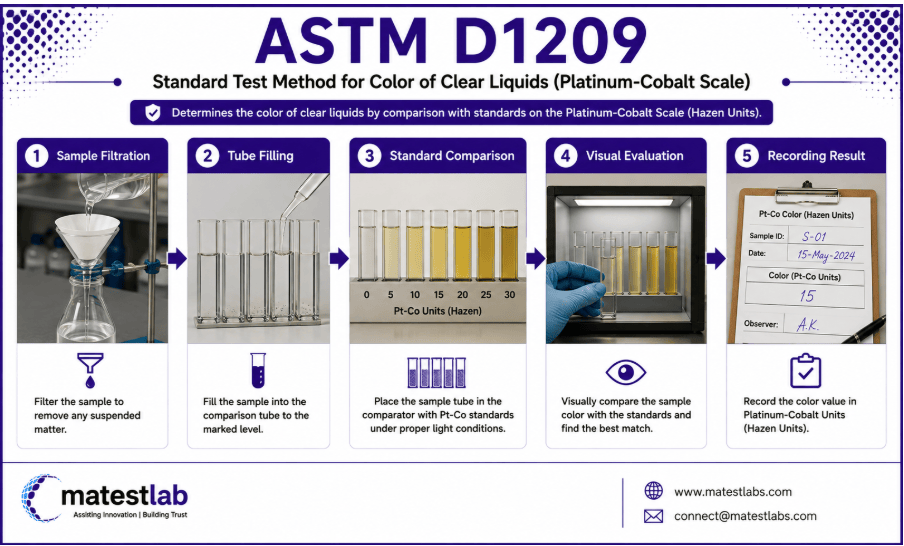
ASTM D1209 Standard Test Method for Color of Clear Liquids (Platinum-Cobalt Scale)

    ASTM D1209 Introduction

    The presence of clear fluids is an important quality parameter in various industries, especially when the product is meant to be used in optical, chemical, or food applications. The ASTM D1209 provides a method to assess color on a consistent, quantitative basis using a platinum-cobalt scale, which is sensitive to yellow. Originally developed for water analysis, the PT-CO scale has been adapted for widespread use in the evaluation of solvents, monomers, and industrial chemicals. By establishing a color value, the method allows manufacturers to monitor the stability of the product, detect impurities and complete the customer specifications. Ensuring reliable communication of color quality between standard producers, suppliers, and end-users.

    Read more

    Get Certified ASTM D1209 for Accurate Color Evaluation

    ASTM D1209 certification is a certifiable standard that assures that clear liquid color measurements are carried out using a standardized procedure. Certified testing guarantees a good comparison of the appearance of the products, assists in the quality assurance programs, and increases customer trust.

    Scope of ASTM D1209

    • It applies to light-colored and transparent liquids.
    • It determines a small yellow discoloration in water-clear material.
    •  It is mainly applied to solvents, chemicals, and refined products.

    ASTM D1209 Equipment and Sample Preparation

    Glass Comparator TubesGlass comparator tubes should be optically transparent, have an inner height of 50 mm, and an outer diameter of 25 mm to be able to visually compare them.
    Pt-Co Standard SolutionsPrepared by means of dissolution of the potassium chloroplatinate and cobalt chloride in the hydrochloric acid, and the resulting standard was allowed to vary between 0 and 500 Pt-Co units.
    Specimen PreparationA priori preparation of the sample should include the removal of particulates, elimination of air bubbles by degassing, and matching to room temperature (23.2) before testing.

    Applications of ASTM D1209

    • Refined fuels and petroleum products.
    • Solvents and chemicals are used in industries.
    • Plasticizers and resins.
    • Raw materials: pharmaceuticals and cosmetics.

    ASTM D1209 Common Challenges and Troubleshooting

    Such common pitfalls are differences in lighting conditions, poor preparation of Pt-Co standards, turbidity of a sample, and subjectivity of one observer versus another. Greater repeatability and accuracy are achieved by making certain that there is uniform illumination, clean comparison tubes, and trained analysts.

    Read more

    ASTM D1209 Aggregate Testing Technique, Process, and Data Collection

    Ready samples are added to color comparison tubes and visually studied in the presence of Platinum-Cobalt reference standards. The analyst determines the standard that best fits the intensity of color of the sample. The color rating is taken as the corresponding Pt-Co value. Testing conditions and observations are recorded to ensure traceability.

    ASTM D1209 Testing Procedure and Requirements

    Visual Color ComparisonThis involves visually comparing the sample in a clear and colorless glass comparator tube to the standard Pt-Co solutions of known concentration.
    Instrumental MeasurementA spectrophotometer, when used, is calibrated with Pt-Co standards, and the sample is measured at 455 nm to identify the intensity of color.
    Color Value AssignmentThe color outcome is indicated as a Pt-Co number (e.g., 10, 50, 100), which is the concentration of the reference standard that is visually or instrumentally equivalent to the sample.

    ASTM D1209 Analysis Results and Interpretation

    Greater Pt-Co values signify less yellow liquids, and the opposite is true. The alterations in color value with time can potentially indicate oxidation, contamination or degradation. Stable low color values are usually used as a sign of purity and product quality in instances where clarity is a requirement.

    Read more

    ASTM D1209 Problem & Solution

    The impurities, oxidation, and processing variations can result in the slight yellow tint of clear liquids, which can impact the appearance of products and their perceived quality.  ASTM D1209 ensures that minor color changes in clear liquids can be effectively detected and reported.

    FAQ

    Where can I get the astm d1209 tested?
    You can share your astm d1209 testing requirements with MaTestLab. MaTestLab has a vast network of material testing laboratories, spread across the USA and Canada. We support your all material testing needs ranging from specific astm d1209 test to various testing techniques.
    Please contact us for a detailed quote for your astm d1209 testing needs. Cost incurred to carry out different astm d1209 testing methodology depends on the type of raw material; number of samples, coupons, or specimens; test conditions, turn around time etc. Costs of some ASTM testing methods start from $100 and the final value depends upon the factors listed above. Please contact us for the best and latest prices.
    The required number of samples or specimens should comply with the procedure given in the astm d1209 standard. However, the MaTestLab operations team can assist you for your special requirements once you share your testing details with us.
    MaTestLab has a vast testing laboratory network, hence we bring you the best testing facilities in a cost-effective way. We offer considerable discounts (15-20%) to our returning customers based on test volume and frequency.
    The turnaround time for astm d1209 test methodology depends upon the test procedure mentioned in the standard test document. However, we at MaTestLab understand your research requirements and hence try to get your test completed within the least possible time.
    content81c70d6e36
    About Author
    content81c70d6e36
    Testimonials
    Real results
    Engineers trust us with what matters most
    Start Your Testing
    Project Today
    Define your requirements and get access to
    specialized laboratories ready to deliver results
    Partners with us
    Clients
    Vendors
    Process for testing
    • STEP 01

      You share your testing requirements

    • STEP 02

      You share your sample(s)

    • STEP 03

      We deliver your test reports

    Get your testing done

    Let us known your testing requirements and we will be right back with a solution.

      Let us root for each other. Collaborate to grow, expand, and accelerate our businesses.

      Partner with us

        Contact Us

        Discover more from MaTestLab

        Subscribe now to keep reading and get access to the full archive.

        Continue reading