MaTestLab > Test Standards > ASTM D1709 Impact Resistance of Plastic Film by the Free-Falling Dart Method
Last updated 4th December 2025
ASTM D1709 Impact Resistance of Plastic Film by the Free-Falling Dart Method
ASTM D1709 is a standard test method used to measure the impact resistance of plastic films using a by the Free-Falling Dart. The test involves dropping a weighted dart onto a plastic film specimen and assessing its ability to withstand impact without puncturing or tearing. ASTM D1709 test method is useful to evaluate the durability and strength of plastic films used in various applications. It is widely used in the packaging industry to assess the toughness and durability of plastic films used in consumer packaging, agricultural coverings, and industrial wrapping. By providing a quantitative measure of a film's impact strength, the standard helps manufacturers ensure product reliability and suitability for real-world handling and performance.
Read More
GET STARTED
ASTM D1709 Introduction
ASTM D1709 provides a standardized procedure for determining the impact resistance of plastic films. The test method simulates real-world scenarios where films may experience impact forces, such as during transportation or handling. By assessing the film’s ability to resist punctures and tears, manufacturers and users can ensure that the films meet specific quality and performance requirements.
ASTM D1709 is a widely recognized testing method employed to assess the impact resistance of plastic films. In essence, this procedure involves dropping a weighted dart onto the film and observing whether it punctures the material. The amount of energy required to cause failure serves as an indicator of the film’s toughness. This method is particularly relevant in industries such as packaging and agriculture, where material durability is essential. By using ASTM D1709, manufacturers can systematically compare the impact strength of different films and ensure their products meet established performance standards.
Service Name
Remarks
ASTM D1709 Testing
Contact US
Certified for Reliable Film Impact Performance
The certification according to ASTM D1709 shows that a laboratory or manufacturer can precisely ascertain the puncture strength of thin plastic films by a controlled dart-drop test procedure. Certified testing assists a designer in choosing films with good toughness of the products, like commodity packages, food bags, shrink films, liners, medical pouches, laminated structures, and geomembranes. It also gives the owners of the brands and regulatory authorities the assurance that the materials are checked in terms of vital mechanical strength.
ASTM D1709 Testing Procedure and Requirements
Test Procedure
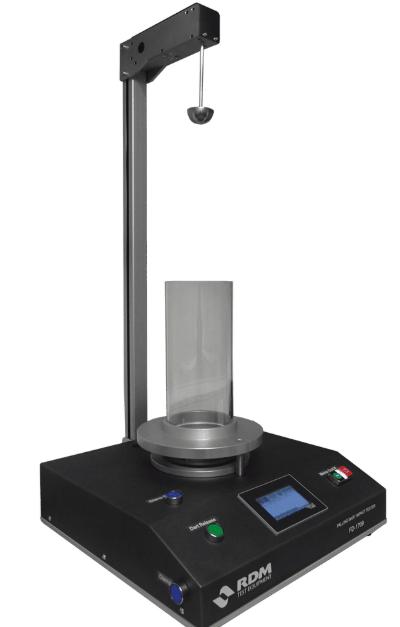
The plastic film specimen is clamped onto a circular frame, creating a taut surface for the impact test. The dart assembly is raised to a specified height within the drop tower. The dart is released to free-fall and strike the centre of the film specimen. The test is repeated using different incremental dart masses to assess a range of impact energies.
Observation and Reporting
After each impact, the film specimen is examined for punctures or tears. The test result is reported as the maximum dart energy or the mass of the dart that caused failure.
Scope of ASTM D1709
ASTM D1709 is used in single- and multilayer plastic films, coextruded films, flexible laminates, shrink films, agricultural sheeting, and packaging film whose thickness is usually less than 1 mm.
The procedure measures the mass of a falling dart that fails under given circumstances and gives a relative measure of the strength of impact.
The approach is a fast and repeatable index of puncture resistance suitable as a quality control measure, research and development, and material comparison, though it is not a replica of all service loading conditions.
ASTM D1709 Equipment and Sample Preparation
Specimen details
ASTM D1709 can be used in plastic films that contain polyethylene (PE), polypropylene (PP), and polyethylene terephthalate (PET).
Specimen dimensions
Rectangular or circular plastic film specimens are prepared according to specified dimensions.
Specimen preparation
The specimens are ensured to be free from any visible defects, wrinkles, or creases.
Use of ASTM D1709
Particularly popular in film production, packaging, polymer laboratory research, agricultural production of films, medical-equipment packaging, development of flexible laminate, and regulatory validation of consumer packaging.
Helps in identifying materials that resist the effects of handling, transportation, and service without tearing or rupturing.
Common Challenges and Troubleshooting in ASTM D1709
The accumulation of electricity on the films can also play a role in generating false results, as they can wear up sooner. The troubleshooting is devoted to the consistent film positioning, checking the alignment of machines, keeping a constant environment state, and changing the dart weight steps in the right direction.
ASTM D1709 Testing Technique, Process, and Data Collection
The first stage in testing is the preparation and conditioning of specimens, the choice of the type of dart, and the drop height. The adjustment of dart masses depends on the pass-fail results, and the results were recorded per trial. Both failure and non-failure observations are recorded by taking note to calculate through statistical methods the mass that results in a probability of 50% to fail in the given standard. Critical mass, environmental parameters, thickness of the specimen, observation of failure, and test parameters are obtained to produce final material performance results.
Analysis, Results, and Interpretation for ASTM D1709
Findings are reported in the form of the dart mass, which causes 50 percent specimen failure. Increasing the mass of darts means that they have better resistance to impact and toughness. Variations in performance among samples could be an indication of non-uniformity, contamination, weak extrusion control, or variation in resin quality. Findings are normally utilised to measure packaging durability, drop-impact, and mechanical goodness.
Problem & The Solution for ASTM D1709
Problem: Inconsistent pass-fail patterns, uneven clamping, incorrect dart selection, improperly conditioned specimens, or misaligned drop equipment can result in unreliable measurements. Solution: Remain constant in conditioning, check the film surfaces before testing, check the position of clamps, mass calibrate the darts, ensure smooth operation of the drop mechanism, and repeat testing to obtain statistical confidence.
Factors to Consider for ASTM D1709
Speed: The technique offers quick cycles of testing and is applicable where quality-control programmes are required to be high-volume.
Expert: Trained staff are required to identify appropriate failures, maintain equipment, and ensure statistical validity, although this is relatively simple.
Cost: Equipment and testing costs are moderate with regard to other mechanical tests, yet the test has high value through preventing product failures, rejects, and packaging weaknesses during the handling, distribution, and storage of the goods.
Related
FAQ's
Where can I get the astm d1709 tested?
You can share your astm d1709 testing requirements with MaTestLab. MaTestLab has a vast network of material testing laboratories, spread across the USA and Canada. We support your all material testing needs ranging from specific astm d1709 test to various testing techniques.
How much do I need to pay for the astm d1709 test?
Please contact us for a detailed quote for your astm d1709 testing needs. Cost incurred to carry out different astm d1709 testing methodology depends on the type of raw material; number of samples, coupons, or specimens; test conditions, turn around time etc. Costs of some ASTM testing methods start from $100 and the final value depends upon the factors listed above. Please contact us for the best and latest prices.
How many samples are required for astm d1709?
The required number of samples or specimens should comply with the procedure given in the astm d1709 standard. However, the MaTestLab operations team can assist you for your special requirements once you share your testing details with us.
How much discount can I get on the astm d1709 test?
MaTestLab has a vast testing laboratory network, hence we bring you the best testing facilities in a cost-effective way. We offer considerable discounts (15-20%) to our returning customers based on test volume and frequency.
How many days will it take to complete the astm d1709 test?
The turnaround time for astm d1709 test methodology depends upon the test procedure mentioned in the standard test document. However, we at MaTestLab understand your research requirements and hence try to get your test completed within the least possible time.
Where can I get the astm d1709 tested?
You can share your astm d1709 testing requirements with MaTestLab. MaTestLab has a vast network of material testing laboratories, spread across the USA and Canada. We support your all material testing needs ranging from specific astm d1709 test to various testing techniques.
MaTestLab Inc. offers accessible, quick, and affordable material testing, product testing, and failure analysis services. We support your on-demand testing and expert consultation needs with the help of our extensive network of material testing laboratories situated in the US and other parts of the world.
MATERIAL TESTING
We offer destructive and non-destructive tests over a range of mechanical, electrical, chemical, thermal, optical, corrosion, radiation, and biological testing methodologies defined by ASTM, ISO and other organizations.
PRODUCT TESTING
We help you evaluate and ensure your product quality and performance with standard and custom-made testing solutions. All the tests are done at well-equipped testing laboratories using standard testing methods for best output and satisfaction.
FAILURE ANALYSIS
Failure analysis ensures high levels of quality in every manufacturing process. We help you with getting the best failure or root cause analysis to determine the cause of the failure. The results help you identify means to prevent failure recurrences.