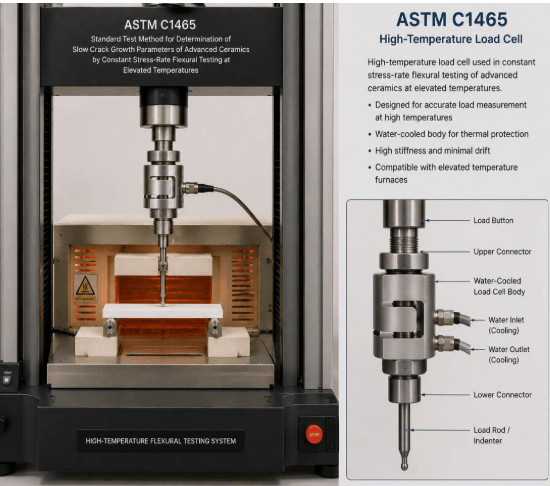
ASTM C1465 provides a procedure for measuring the parameters of slow crack growth of advanced ceramic materials through constant stress rate flexural testing at high temperatures. The method is designed for materials with low creep and is suitable for testing in air, vacuum, inert gases, and other controlled gaseous environments to characterize materials and for quality assurance. This standard method-
- Covers advanced ceramic materials.
- Determines slow crack growth parameters.
- Applies constant stress rate flexural testing.
- Usable in air, vacuum, inert, and other gas environments.
- Assists with material preparation and control.
- Produces data for material characterization and simple engineering design.
What are the Uses of ASTM C1465 Testing?
ASTM C1465 determines the slow crack growth (SCG) parameters of advanced ceramics through constant stress-rate flexural testing at elevated temperatures. The test assesses the crack propagation characteristics, forecasts long-term structural reliability, and qualifies high-temperature service ceramics.
- Determines slow crack growth parameters of advanced ceramics.
- Carries out high-temperature fracture analyses.
- Determines the flexural strength under various rates of loading.
- Supports development of materials and qualifications.
- Helps with quality control and reliability testing.
- Compares the performance of ceramic material at high temperatures.
- Aids in engineering design and service life prediction.
Which Materials Can Be Tested to ASTM C1465?
For laboratory use, ASTM C1465 tests monolithic advanced ceramics with low creep values. The laboratory uses this method to test structural engineering ceramics at elevated temperatures in a controlled environment.
Why is ASTM C1465 Important?
ASTM C1465 offers a standardized approach to slow crack growth testing at elevated temperatures of advanced ceramics. It enables manufacturers to predict long-term material behavior, enhance component reliability, and provide reliable information for engineering design and material qualification.
Common Challenges and Troubleshooting
Accurately machined specimens with stable furnace temperature, constant stress rate loading, and specimen alignment are essential for producing reliable slow crack growth test results. Common problems include machine operations, temperature instability, stress-rate variability, misaligned fixtures, handling damage, premature failure from mishandling, and calibration errors. Specimen preparation, testing conditions, and regular calibration guarantee accurate and repeatable results.
ASTM C1465 Testing Process and Data Collection
Testing starts with the preparation of representative rectangular ceramic flexural specimens with specified dimensions. The technicians load the specimen into a high-temperature furnace attached to a flexural testing machine under the desired test temperature. After this, technicians apply flexural loading to the specimen at a certain constant loading stress until fracture occurs. The procedure repeats at multiple stress rates to determine the influence of loading rate on fracture strength. During testing, the technician records the specimen dimensions, test temperature, applied stress, applied load, flexural strength, and failure. Engineers use these data to calculate the material’s slow crack growth parameters.